


Aerial Gym Simulator
Welcome to the documentation of the Aerial Gym Simulator
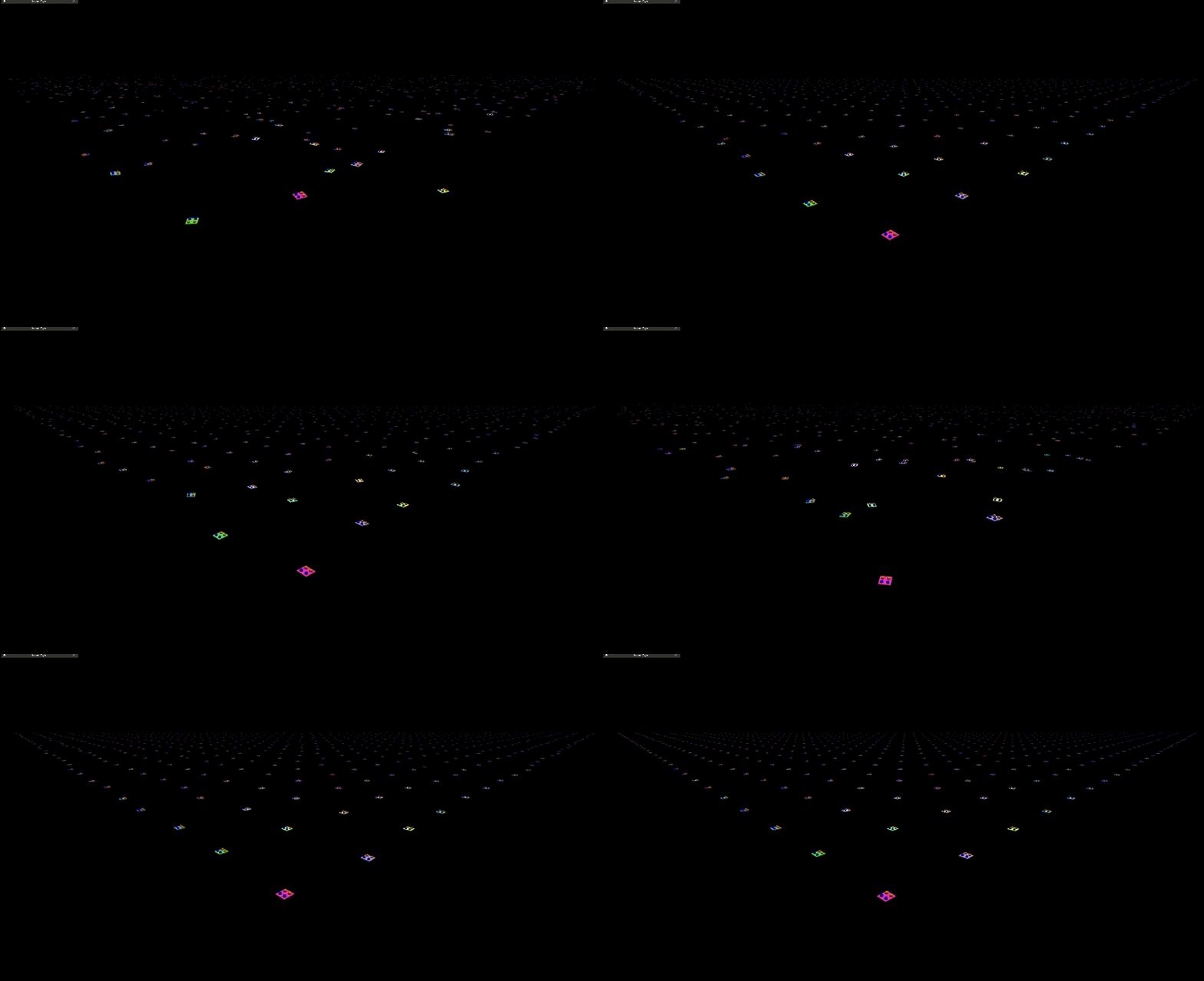
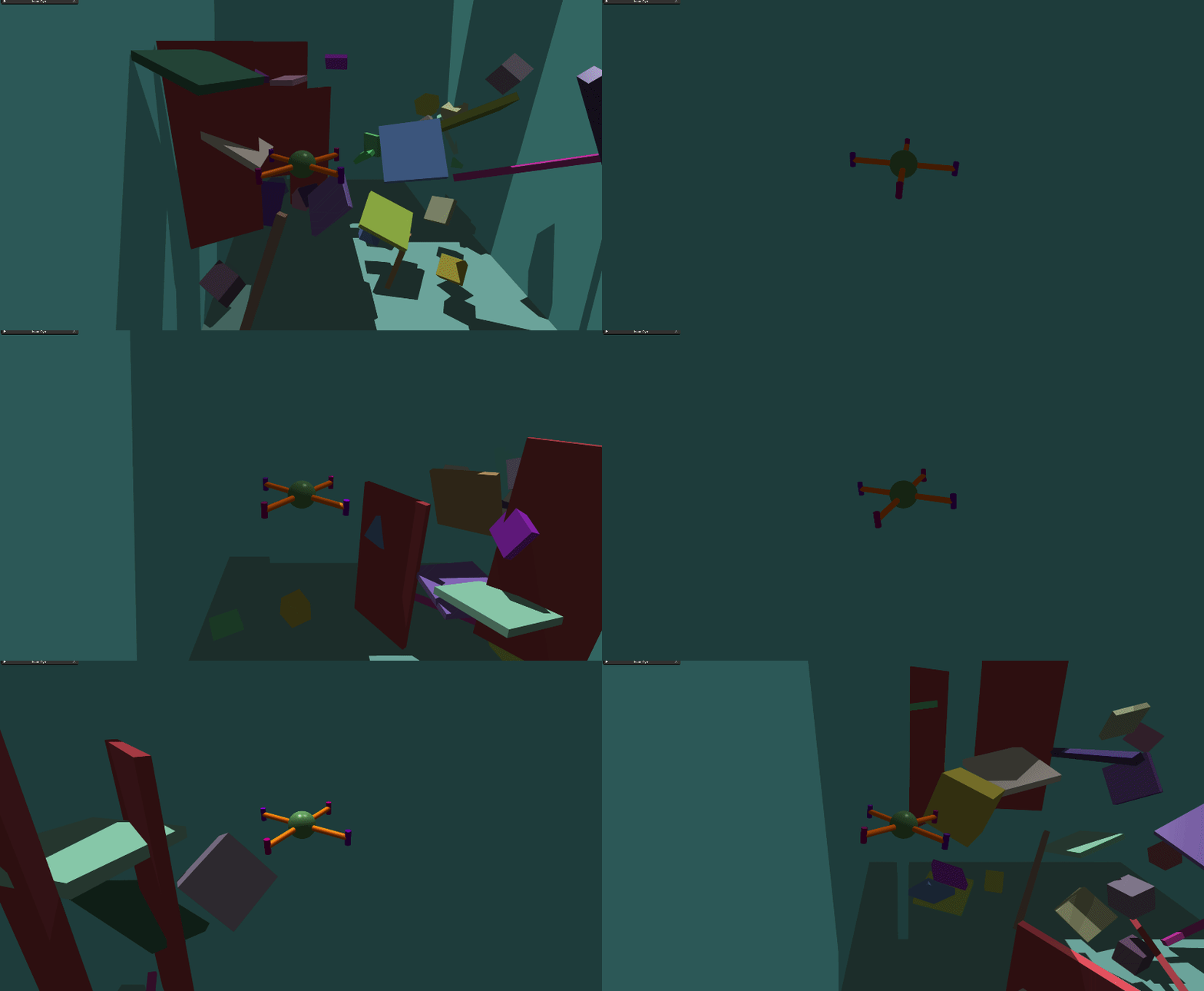
The Aerial Gym Simulator is a high-fidelity physics-based simulator for training Micro Aerial Vehicle (MAV) platforms such as multirotors to learn to fly and navigate cluttered environments using learning-based methods. The environments are built upon the underlying NVIDIA Isaac Gym simulator. We offer aerial robot models for standard planar quadrotor platforms, as well as fully-actuated platforms and multirotors with arbitrary configurations. These configurations are supported with low-level and high-level geometric controllers that reside on the GPU and provide parallelization for the simultaneous control of thousands of multirotors.
This is the second release of the simulator and includes a variety of new features and improvements. Task definition and environment configuration allow for fine-grained customization of all the environment entities without having to deal with large monolithic environment files. A custom rendering framework allows obtaining depth, and segmentation images at high speeds and can be used to simulate custom sensors such as LiDARs with varying properties. The simulator is open-source and is released under the BSD-3-Clause License.
Support for Unified Autonomy Stack
Support for the Unified Autonomy Stack is now available! Training instructions can be found in the RL Training page.
Features
- Modular and Extendable Design — easily create custom environments, robots, sensors, tasks, and controllers, and change parameters programmatically on-the-fly via the Simulation Components.
- Rewritten from the Ground-Up — very high control over each simulation component with extensive customization capabilities.
- High-Fidelity Physics Engine — leverages NVIDIA Isaac Gym for simulating multirotor platforms, with support for custom physics backends and rendering pipelines.
- Parallelized Geometric Controllers — reside on the GPU and provide parallelization for the simultaneous control of thousands of multirotors.
- Custom Rendering Framework — based on NVIDIA Warp, used to design custom sensors and perform parallelized kernel-based operations.
- Fully Customizable — create custom environments, robots, sensors, tasks, and controllers.
- RL-based control and navigation policies — includes scripts to get started with training your own robots.
Support for Isaac Lab
Support for Isaac Lab and Isaac Sim is now available! Multirotor/thruster actuator, multirotor asset, and manager-based ARL drone task have been added in Isaac Lab v2.3.2.
Results using the Aerial Gym Simulator
Why Aerial Gym Simulator?
The Aerial Gym Simulator is designed to simulate thousands of MAVs simultaneously and comes equipped with both low and high-level controllers that are used on real-world systems. In addition, the new customized ray-casting allows for superfast rendering of the environment for tasks using depth and segmentation from the environment.
The optimized code in this newer version allows training for motor-command policies for robot control in under a minute and vision-based navigation policies in under an hour. Extensive examples are provided to allow users to get started with training their own policies for their custom robots quickly.
Citing
The paper for this simulator is available on arXiv:2503.01471 and IEEE Xplore. When referencing the Aerial Gym Simulator in your research, please cite:
@article{kulkarni2025aerial,
  title={Aerial gym simulator: A framework for highly parallelized simulation of aerial robots},
  author={Kulkarni, Mihir and Rehberg, Welf and Alexis, Kostas},
  journal={IEEE Robotics and Automation Letters},
  year={2025},
  publisher={IEEE}
}
If you use the reinforcement learning policy provided alongside this simulator for navigation tasks, please cite the following paper:
@INPROCEEDINGS{kulkarni2024@dceRL,
  author={Kulkarni, Mihir and Alexis, Kostas},
  booktitle={2024 IEEE International Conference on Robotics and Automation (ICRA)},
  title={Reinforcement Learning for Collision-free Flight Exploiting Deep Collision Encoding},
  year={2024},
  volume={},
  number={},
  pages={15781-15788},
  keywords={Image coding;Navigation;Supervised learning;Noise;Robot sensing systems;Encoding;Odometry},
  doi={10.1109/ICRA57147.2024.10610287}}
Quick Links
For your convenience, here are some quick links to the most important sections of the documentation:
- Installation
- Robots and Controllers
- Sensors and Rendering Capabilities
- RL Training
- Simulation Components
- Customization
- Sim2Real Deployment
- FAQs and Troubleshooting
Contact
Mihir Kulkarni Email GitHub LinkedIn X (formerly Twitter)
Welf Rehberg Email GitHub LinkedIn
Theodor J. L. Forgaard Email GitHb LinkedIn
Kostas Alexis Email GitHub LinkedIn X (formerly Twitter)
This work is done at the Autonomous Robots Lab, Norwegian University of Science and Technology (NTNU). For more information, visit our Website.
Acknowledgements
This material was supported by RESNAV (AFOSR Award No. FA8655-21-1-7033) and SPEAR (Horizon Europe Grant Agreement No. 101119774).
This repository utilizes some of the code and helper scripts from https://github.com/leggedrobotics/legged_gym and IsaacGymEnvs.
FAQs and Troubleshooting
Please refer to our website or to the Issues section in the GitHub repository for more information.