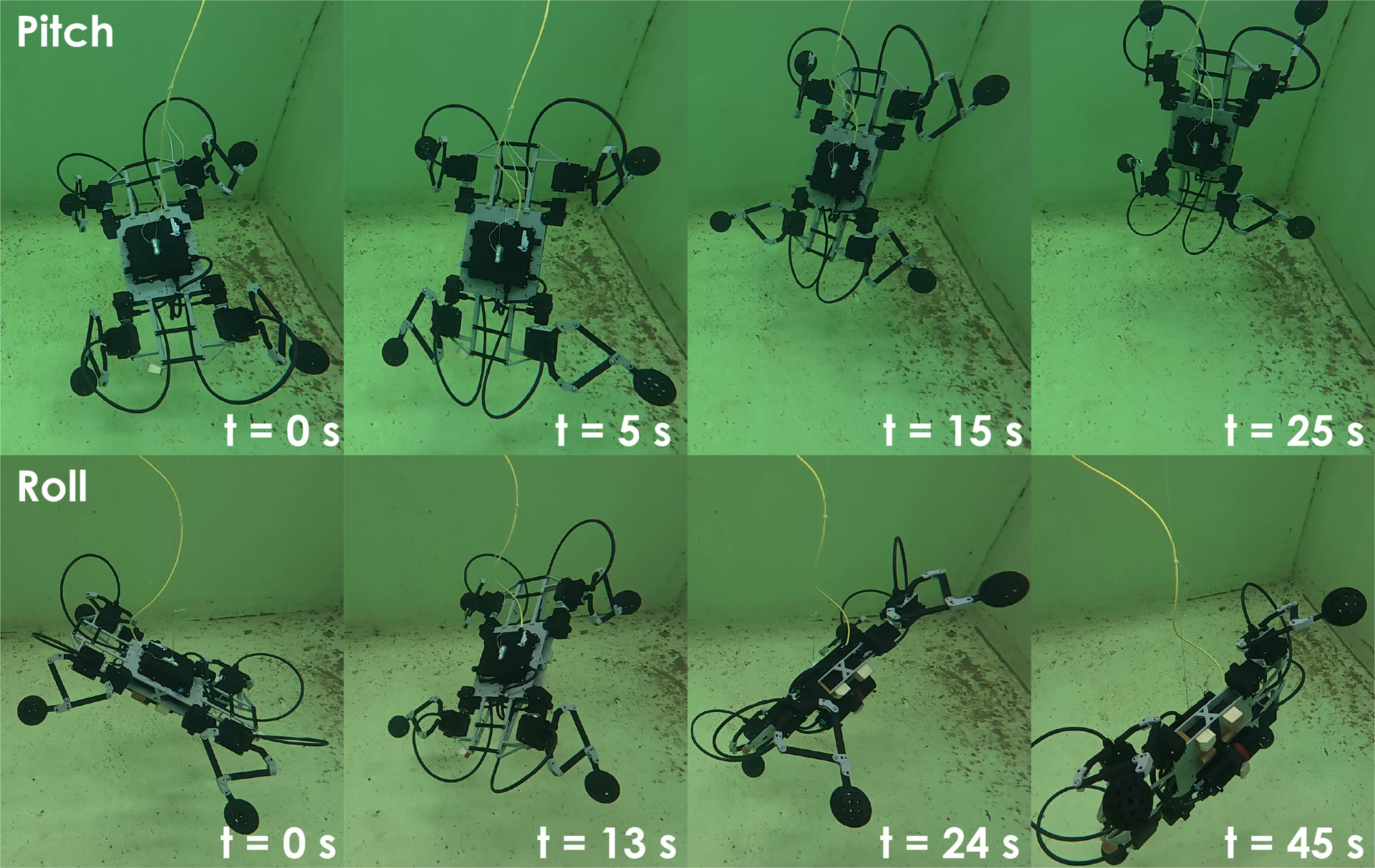
The underwater quadruped robot tracking roll and pitch attitude setpoints in a water tank.
Abstract
Legged robots are versatile on land, but their use in underwater environments remains
limited. Extending quadruped locomotion to water enables amphibious mobility with
applications in inspection, environmental monitoring and disaster response. This paper
presents the design, modeling, and experimental validation of a reproducible underwater
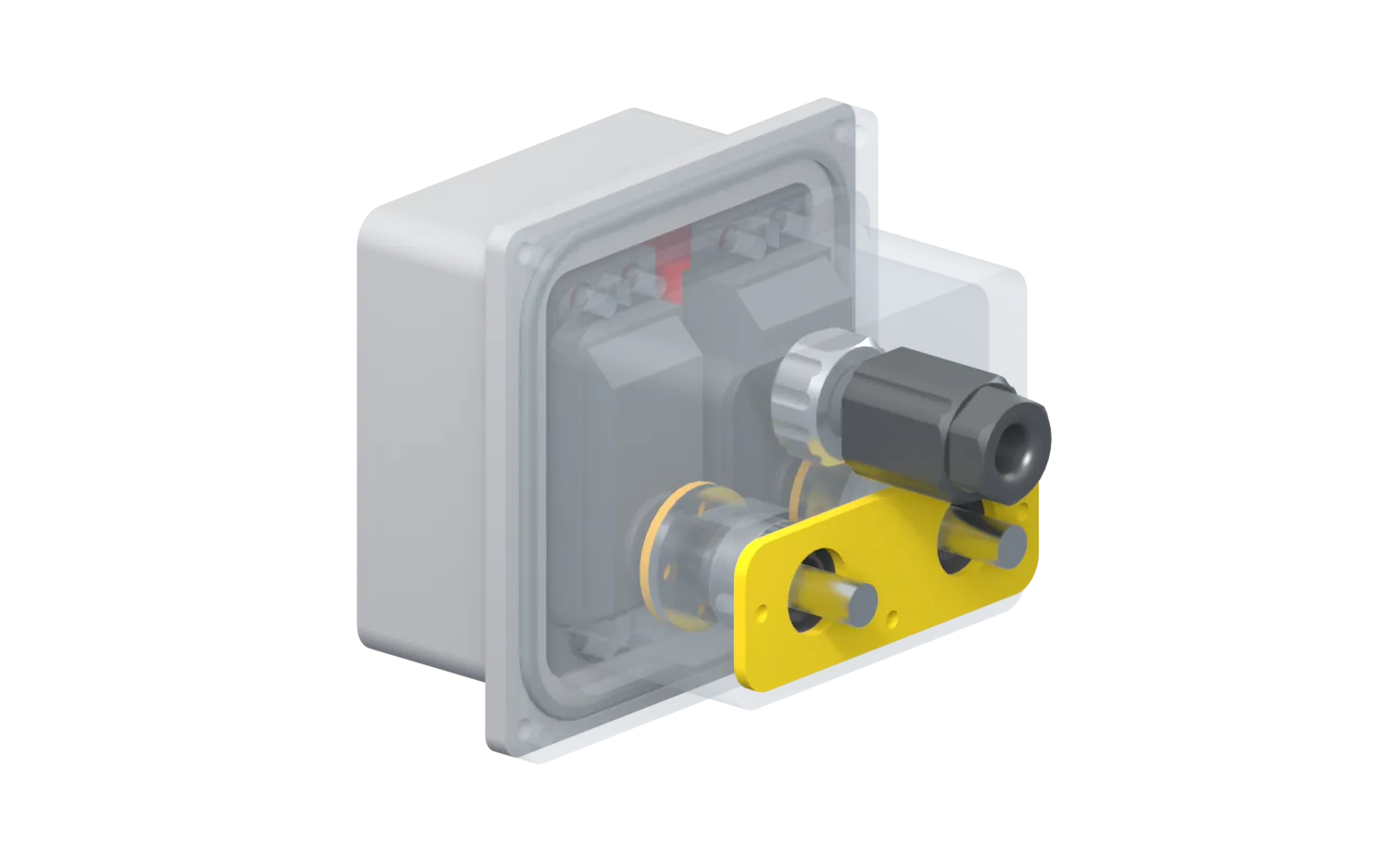
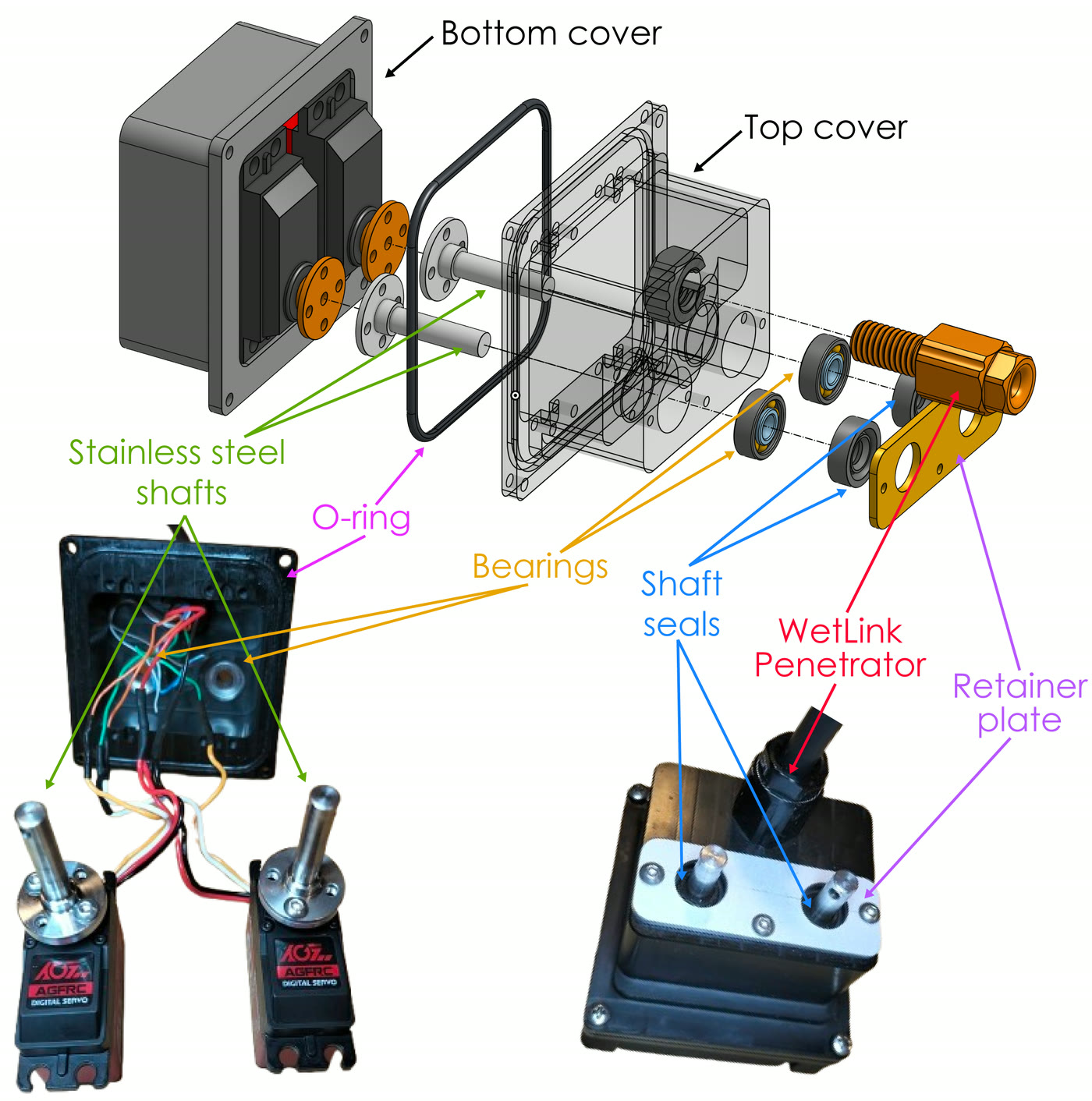
quadruped robot. The robot is built around custom waterproof motor housings machined
from polyoxymethylene plastic, which use off-the-shelf O-rings and dynamic shaft seals.
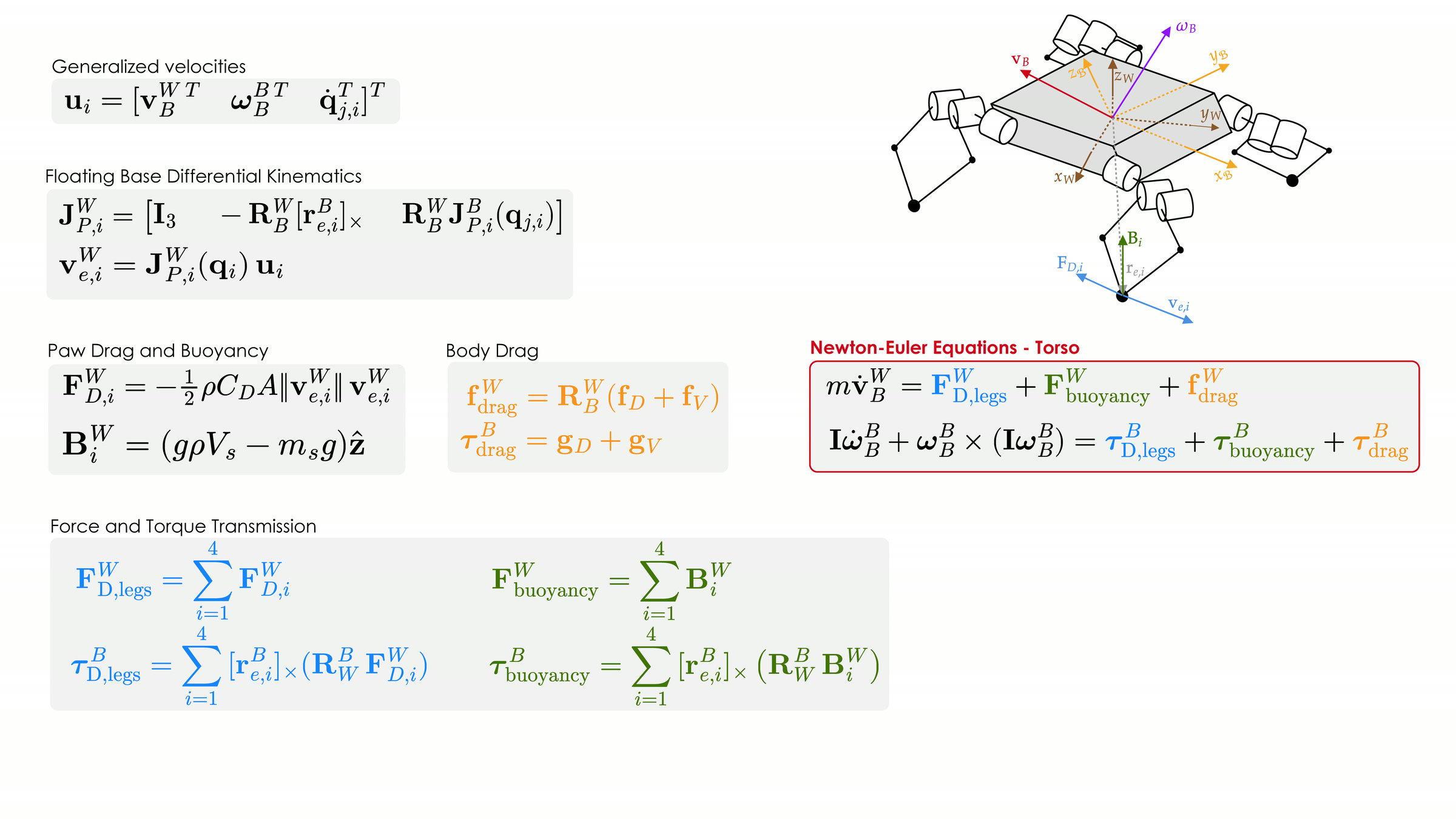
A simplified model is derived to describe the dynamics of this underwater legged system,
capturing how drag forces on spherical end effectors transmit torque to the floating
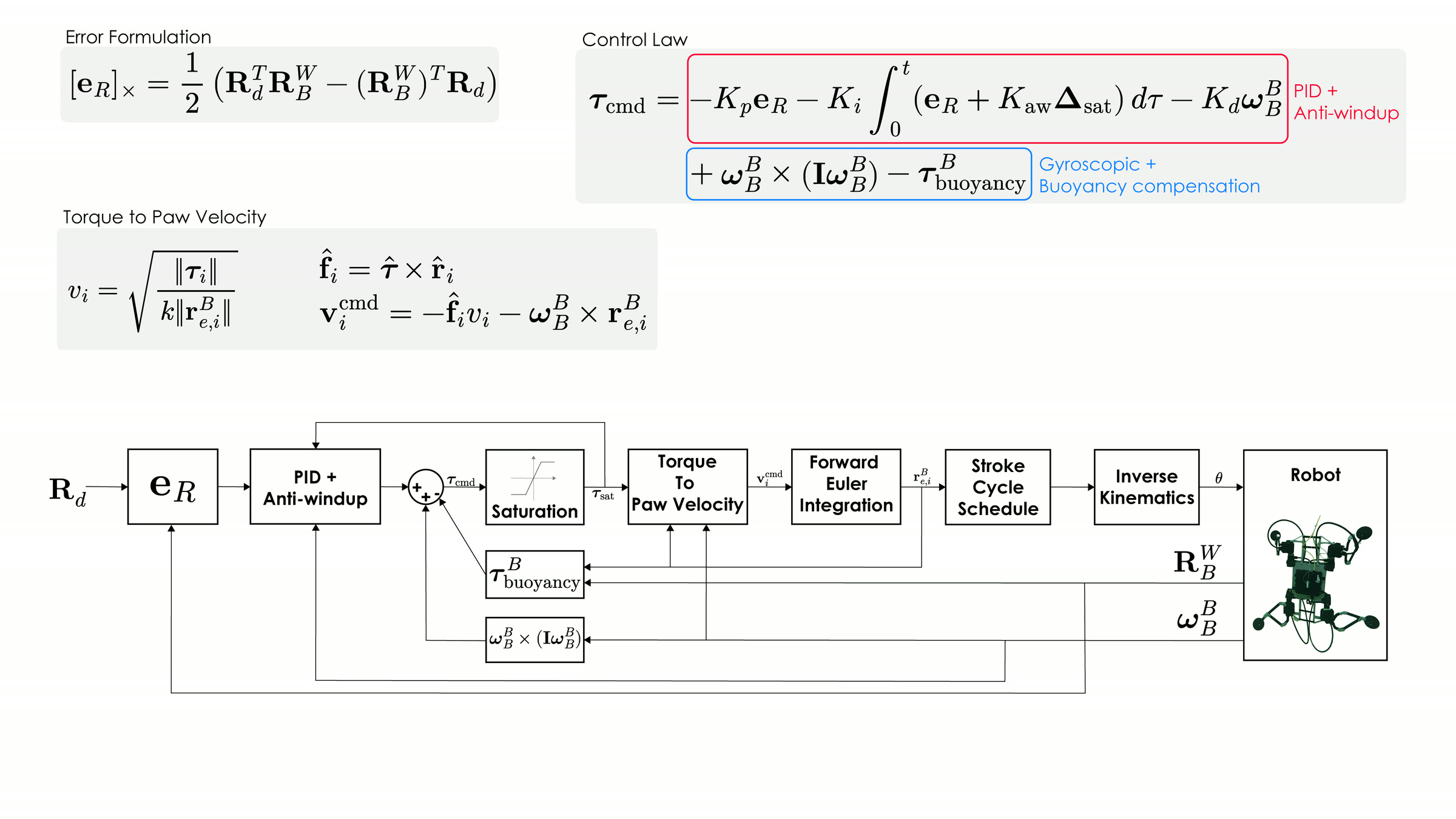
base. Building on this model, a closed-loop attitude controller is developed using an
error formulation defined on the special orthogonal group SO(3). The controller
is evaluated both in simulation and experimentally in a water tank, where the robot
tracks desired orientation setpoints in roll, pitch and yaw.
Robot Design
3D Model
Drag to orbit · scroll to zoom
Body: 58.99 × 34.44 × 15.33 cm, 4.9 kg
Actuators: 12 × AGF-RC IB53BHU, 3.9 Nm
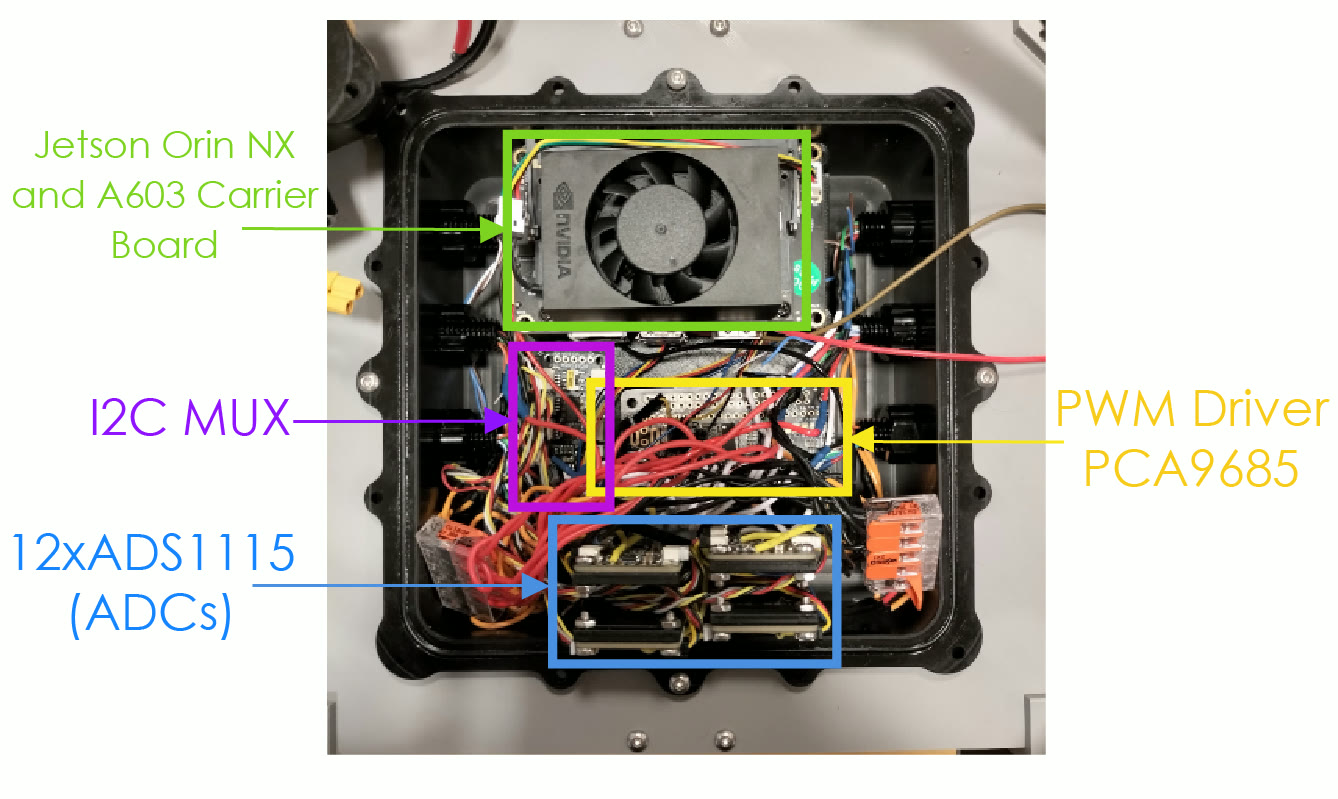
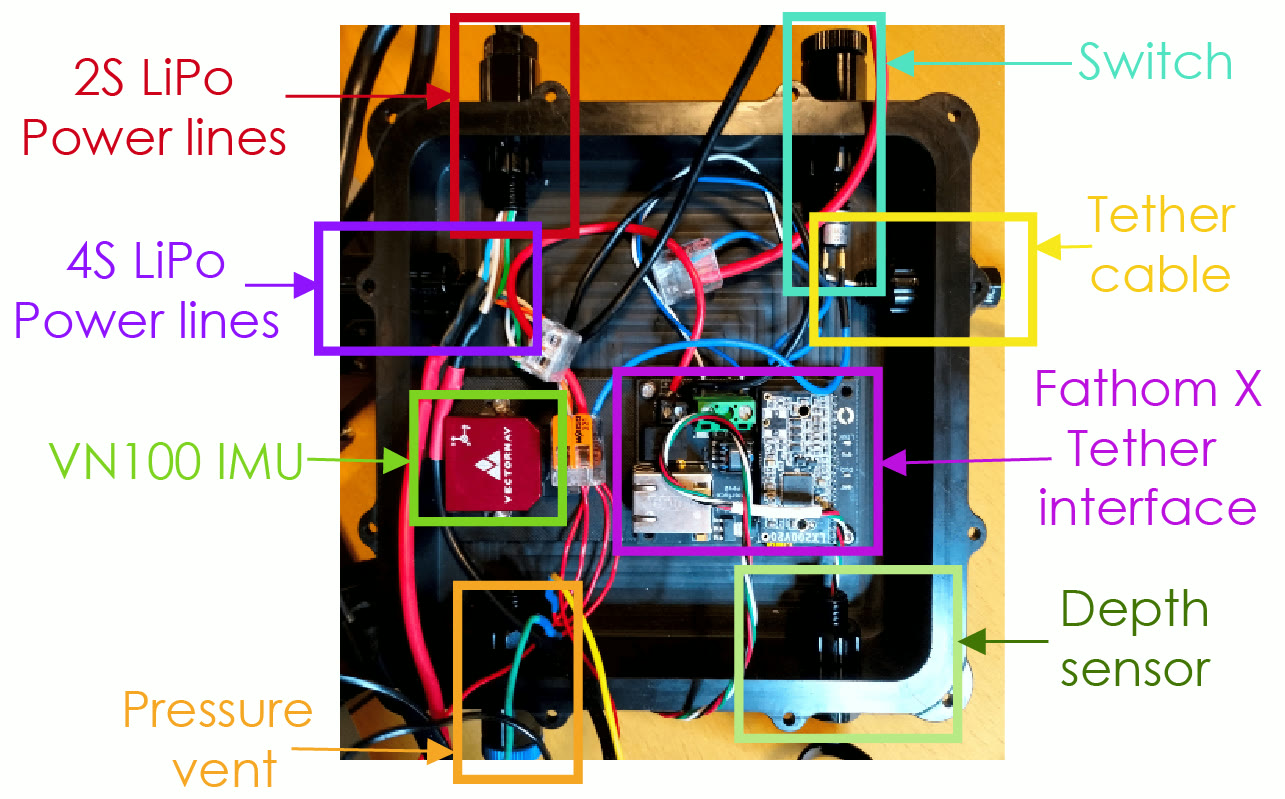
OBC: NVIDIA Jetson Orin NX + A603 Carrier Board
Power: 2S 3500 mAh + 4S 550 mAh LiPo
Waterproofing
Servo enclosure
Loading assembly sequence
Top cover
Drag the slider or press Play to build the housing up part by
part.Exploded view and real-world assembly of the servo enclosure.
Main electronics enclosure
Bottom half of the main electronics enclosure.Top half of the main electronics enclosure.
Model and Controller
Simplified model
Attitude Controller
Experiments
Maneuver
Setpoint
Cite
BibTeX
Reference
@misc{molinaroli2026designattitudecontrolunderwater,
      title={Design and Attitude Control of an Underwater Quadruped Robot},
      author={Davide Molinaroli and Mohit Singh and Kostas Alexis},
      year={2026},
      eprint={2609.09217},
      archivePrefix={arXiv},
      primaryClass={cs.RO},
      url={https://arxiv.org/abs/2609.09217},
}