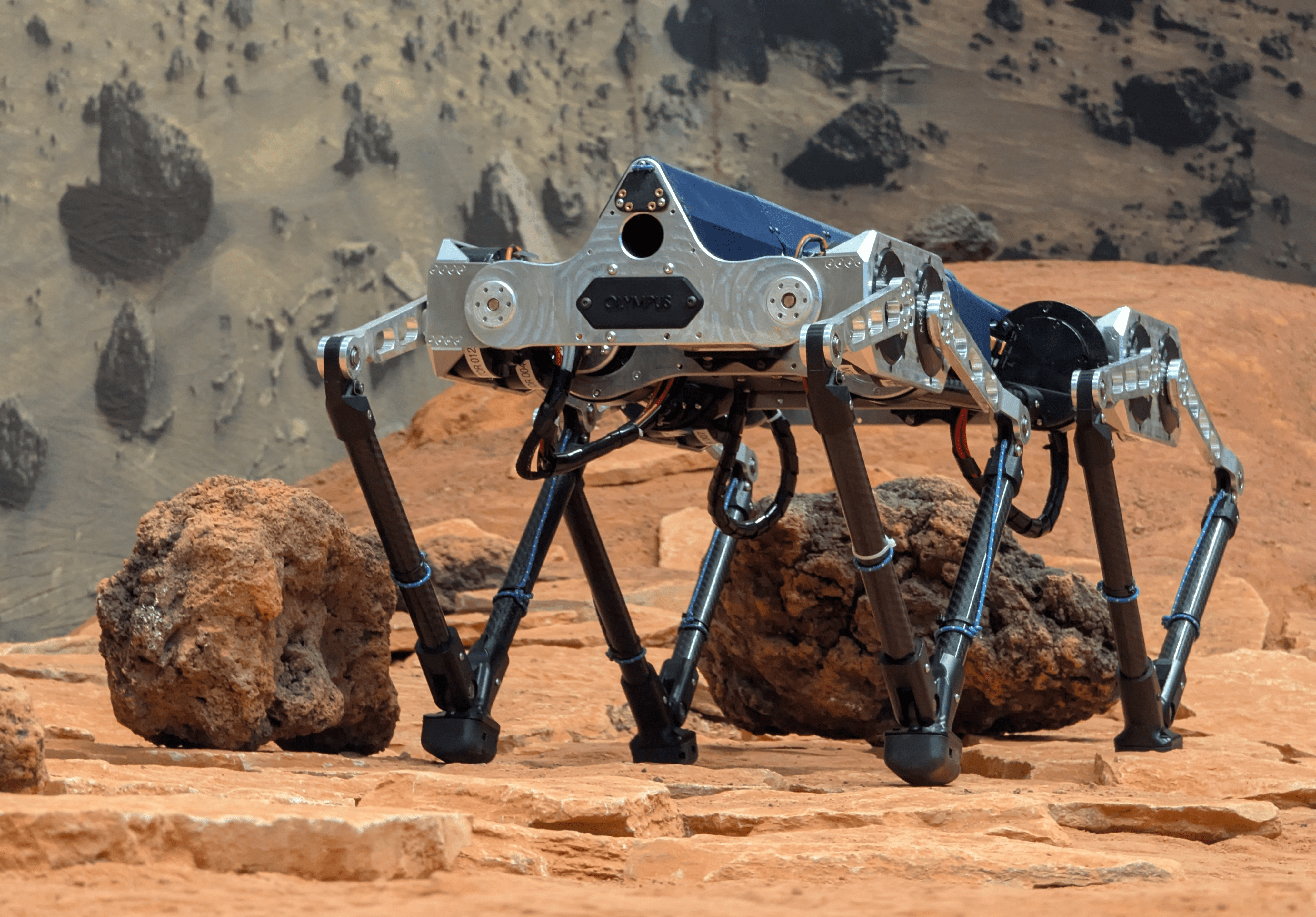
As scientific interest shifts toward more diverse geological regions on Mars and the Moon, including steep crater rims, boulder fields, and lava tubes, traditional wheeled rovers face fundamental limitations in accessing these scientifically valuable sites. These challenging terrains offer direct access to geological history and potential resources, yet remain largely out of reach for conventional platforms.
Olympus addresses this limitation through a fundamentally different approach: a jumping quadruped robot designed for Mars' reduced gravity environment. By combining powerful jumping capabilities with precise in-flight attitude control and walking, Olympus can traverse obstacles several times its body size, enabling exploration of terrain where conventional rovers would struggle.
Wheeled rovers have proven highly successful on relatively flat terrain, yet they struggle with larger obstacles and can become immobilized on steep slopes or in loose regolith. Helicopters like Ingenuity provide aerial vantage points and faster traversal, but face significant payload limitations and navigation challenges in low-light, feature-poor environments.
Among the most scientifically valuable yet challenging targets are Martian lava tubes (shown below). These subsurface structures preserve geological records protected from surface erosion and radiation, may contain accessible water ice for in-situ resource utilization, and could provide natural shelter for future human missions. Yet their steep slopes, boulder-filled passages, and collapsed sections place them beyond the capabilities of conventional rovers.
Mars' reduced gravity (3.71 m/s²) fundamentally transforms the possibilities for legged locomotion. Dynamic maneuvers that would be difficult or impossible on Earth become achievable, allowing robots to clear obstacles multiple times their body size through powerful jumps. This capability is essential for accessing Martian lava tubes, navigating rough terrain, and traversing steep slopes.
However, successful jumping requires solving significant control challenges. After takeoff, the robot experiences extended flight phases lasting several seconds with no ground contact. During this time, it must reorient itself using only its legs as reaction masses to ensure proper landing orientation. Additionally, takeoffs from uneven terrain or loose regolith can introduce unwanted rotations that must be corrected mid-flight.
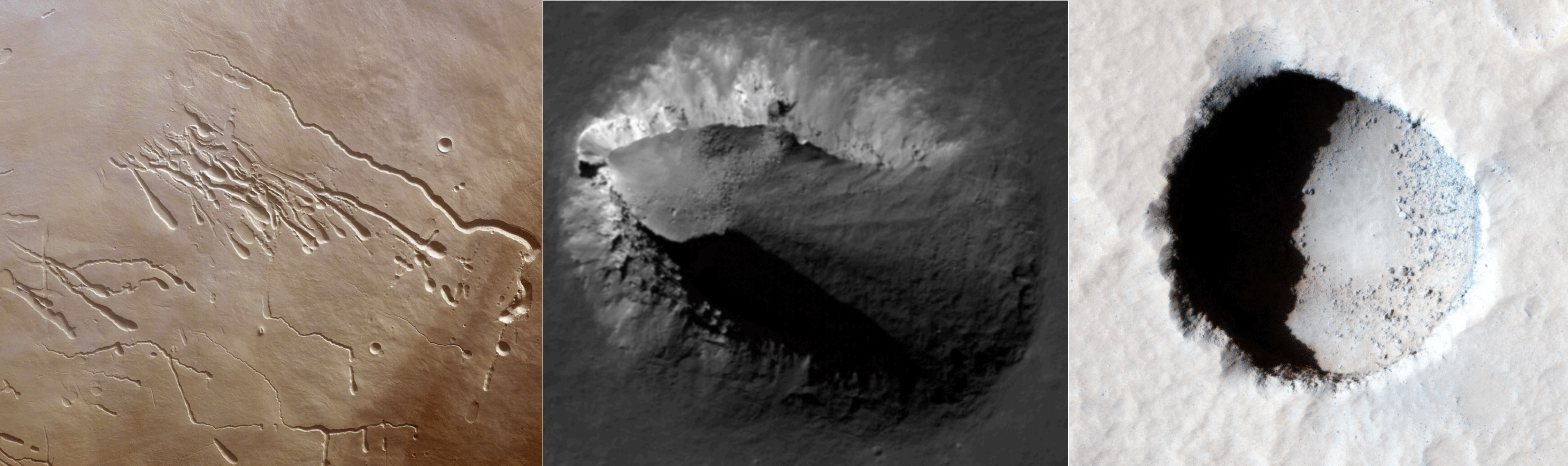
Left: Orbital view of Martian lava tube network on Pavonis Mons, Center: Lacus Mortis lunar pit, Right: Martian lava tube skylight near Elysium Mons. Credits: ESA/DLR/FU Berlin; NASA/GSFC/ASU; NASA/JPL/Univ. of Arizona.
The Olympus design was optimized specifically for Mars gravity environments through systematic exploration of the morphological design space. A grid search over body dimensions and leg parameters identified the configuration that maximizes vertical jump height, horizontal jump distance, and in-flight angular reorientation capabilities.
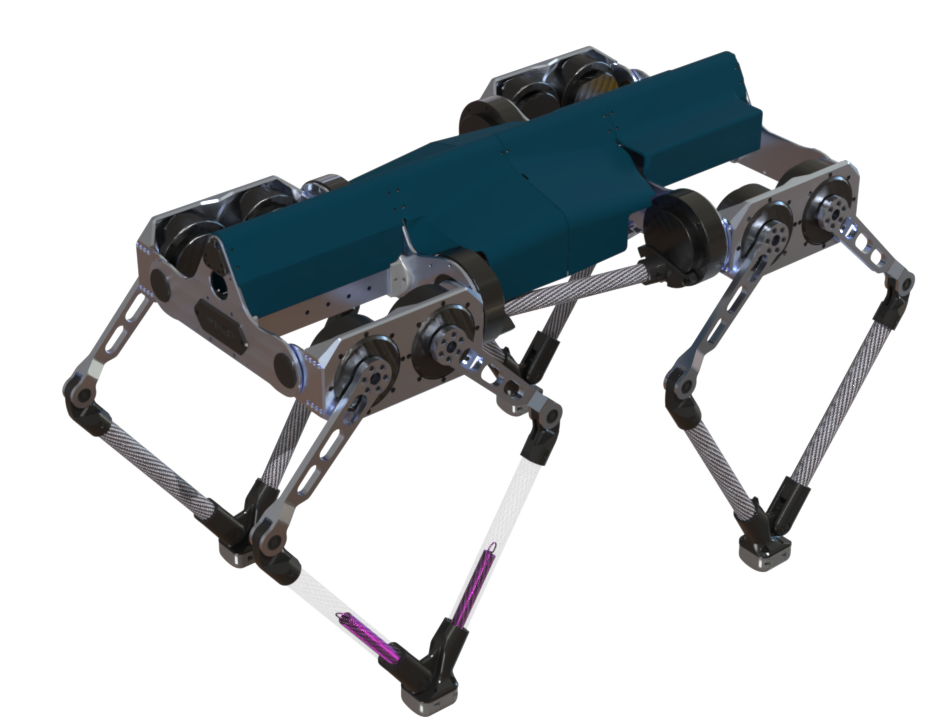
The robot employs a 5-bar linkage leg design with three degrees of freedom per leg. This configuration provides both a large workspace for in-flight attitude control and excellent jumping performance through dual-motor force contribution during takeoff.
Jumping legged robots face unique control challenges. The robot must coordinate powerful takeoff maneuvers, maintain stability during flight phases lasting several seconds without ground contact, and execute controlled landings on uncertain terrain. This work develops reinforcement learning policies for jumping, walking, and in-flight attitude control, with an additional model predictive control approach investigated for attitude stabilization.
A curriculum-based reinforcement learning framework utalizing reference state initialization across all jump phases (standing, flight, landing) and projectile motion-based rewards accelerate learning. Achieving centimeter-level precision: 1.25m horizontal and 1.01m vertical jumps on robot hardware in Earth gravity, with jumps reaching 3.9m horizontal and 3.1m vertical in Martian gravity. A walking policy enables terrain traversal between jumps.
A deep reinforcement learning framework for in-flight attitude control that uses coordinated leg movements to redistribute angular momentum and reorient the robot during flight. Validated on hardware with 90° single-axis rotations achieved in 2.6 seconds and smooth multi-axis maneuvers, ensuring proper landing orientation after jumps from uneven takeoff surfaces.
A hierarchical nonlinear model predictive control approach was also developed and validated for in-flight attitude control, demonstrating an alternative model-based solution to the RL approach.
Integrated deployment of walking, jumping, and attitude control policies in a simulated Martian exploration scenario, demonstrating coordinated navigation through challenging terrain.
Simulated Mars exploration mission demonstrating obstacle traversal through coordinated walking, vertical and horizontal jumping, and in-flight attitude stabilization under Martian gravity (3.71 m/s²).
We release both the mechanical design and reinforcement learning framework as open-source contributions to advance research in dynamic legged locomotion and planetary exploration robotics.
Complete mechanical design files including CAD models, 5-bar linkage specifications, and bill of materials for the Olympus quadruped platform.
Reinforcement learning framework for training walking, jumping, and attitude control policies. Built on Isaac Lab with curriculum-based reinforcement learning training and reference state initialization to accelerate learning of dynamic jumping behaviour. Includes separate branches for Earth and Mars gravity environments.
Dynamic Jumping & Walking (Earth)
Mars Exploration & Attitude Control
Olympus Design & Attitude Control (ICRA 2025)
In-Flight Attitude Control (CoRL 2024)
Model-Based Torso Stabilization (ISRR 2024)
Model Predictive Attitude Control (IEEE Aerospace 2024)
Design Verification (ICAR 2023)
arXiv preprint 2025
ICRA 2025 (IEEE International Conference on Robotics and Automation)
Submitted for conference review, 2025
CoRL 2024 (Conference on Robot Learning)
ISRR 2024 (International Symposium on Robotics Research)
IEEE Aerospace Conference 2024
ICAR 2023 (International Conference on Advanced Robotics)
IAC 2023 (International Astronautical Congress)