Task-Driven Closed-Loop Design Optimization of Passively Morphing Quadrotors for Contact-Mediated Narrow Gap Traversal

Etor Arza1, Luca Girardi2, Gabriel Maquignaz2, Javier Paez1, Stefan Leutenegger2, Stefano Mintchev3, Kostas Alexis1

1Norwegian University of Science and Technology (NTNU)   2ETH Zurich   3University of Bonn

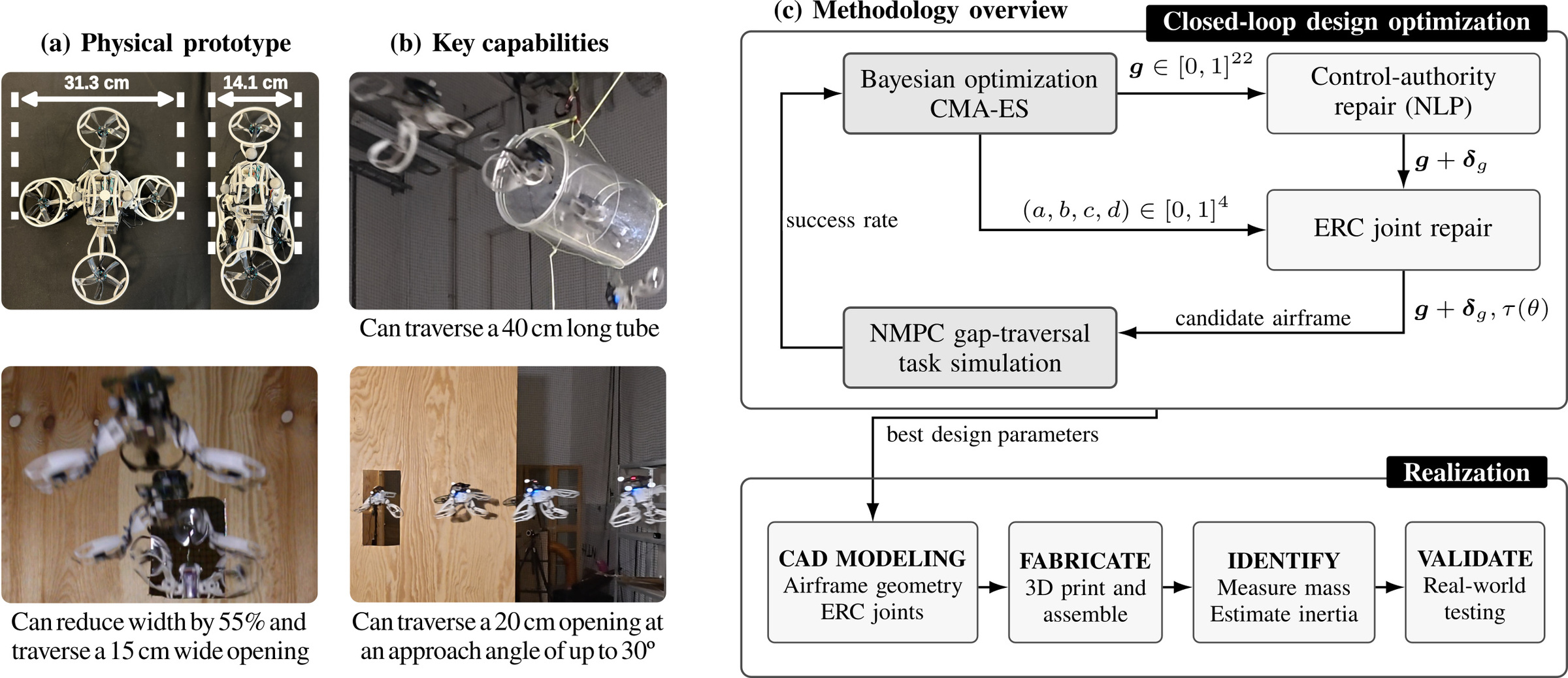
Prototype in extended and folded configurations, its capabilities, and the optimization pipeline.

Narrow gap traversal

The drone crosses a 15 cm wide opening, less than half of its 31.3 cm nominal width and only slightly wider than its 14.1 cm folded width. The gap edges fold both arms, which re-extend after the crossing while the controller recovers hover.
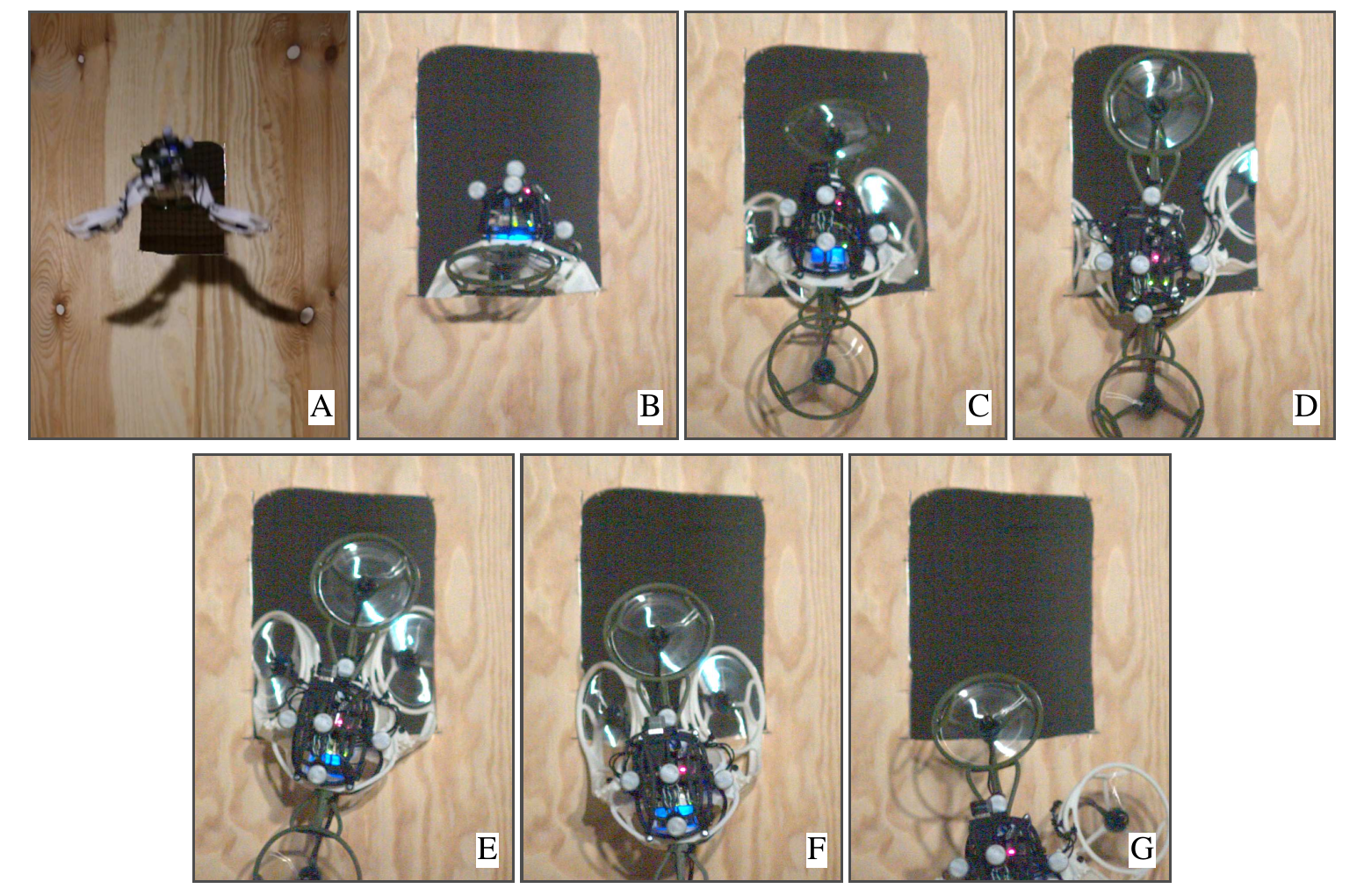
Video frames of the gap traversal.

Confined tube

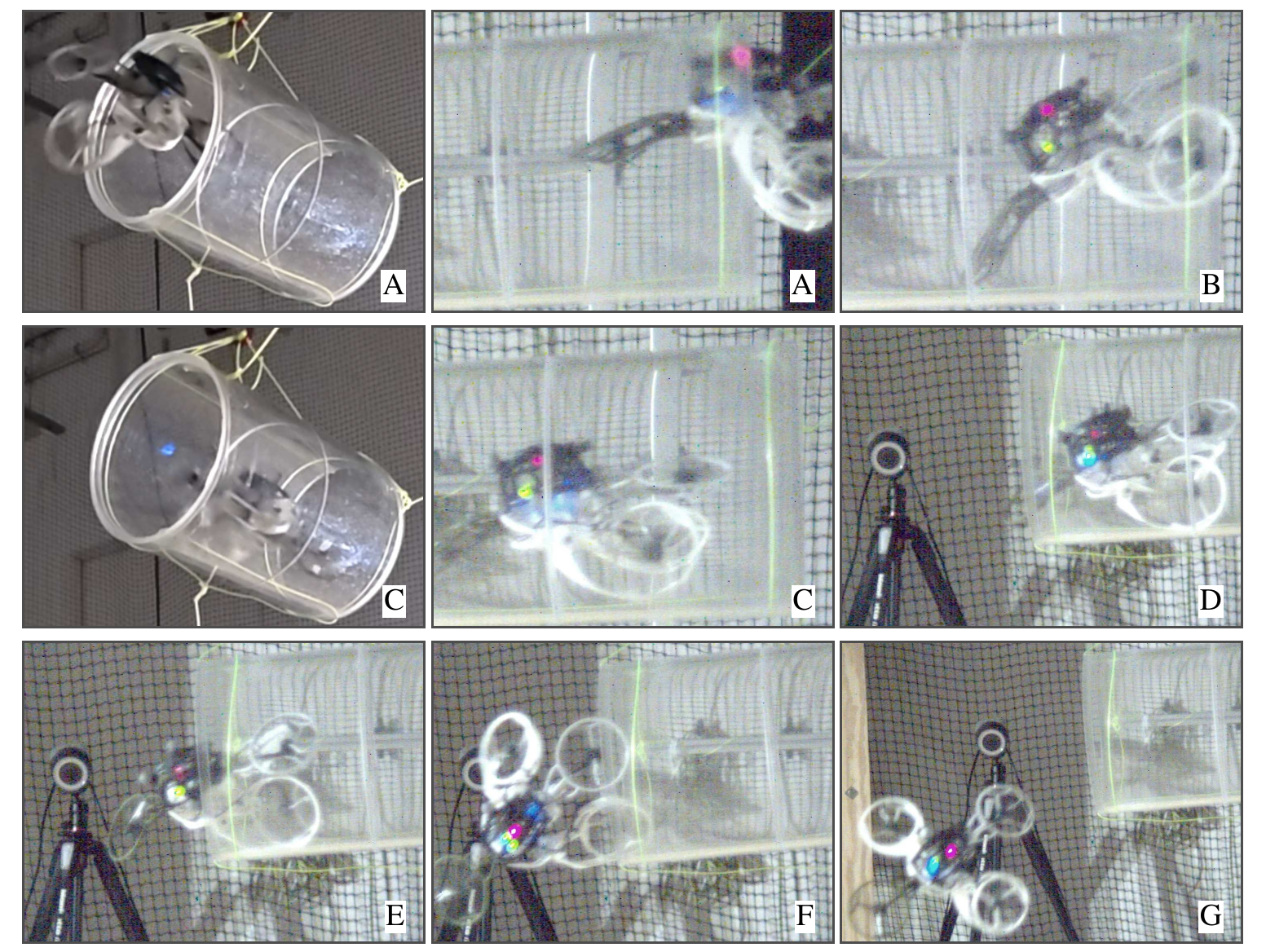
The tube is 40 cm long with a 22.5 cm diameter, which is 72% of the extended width. The tube holds both arms folded while the drone passes through.

Video frames of the tube traversal.

Approach angles

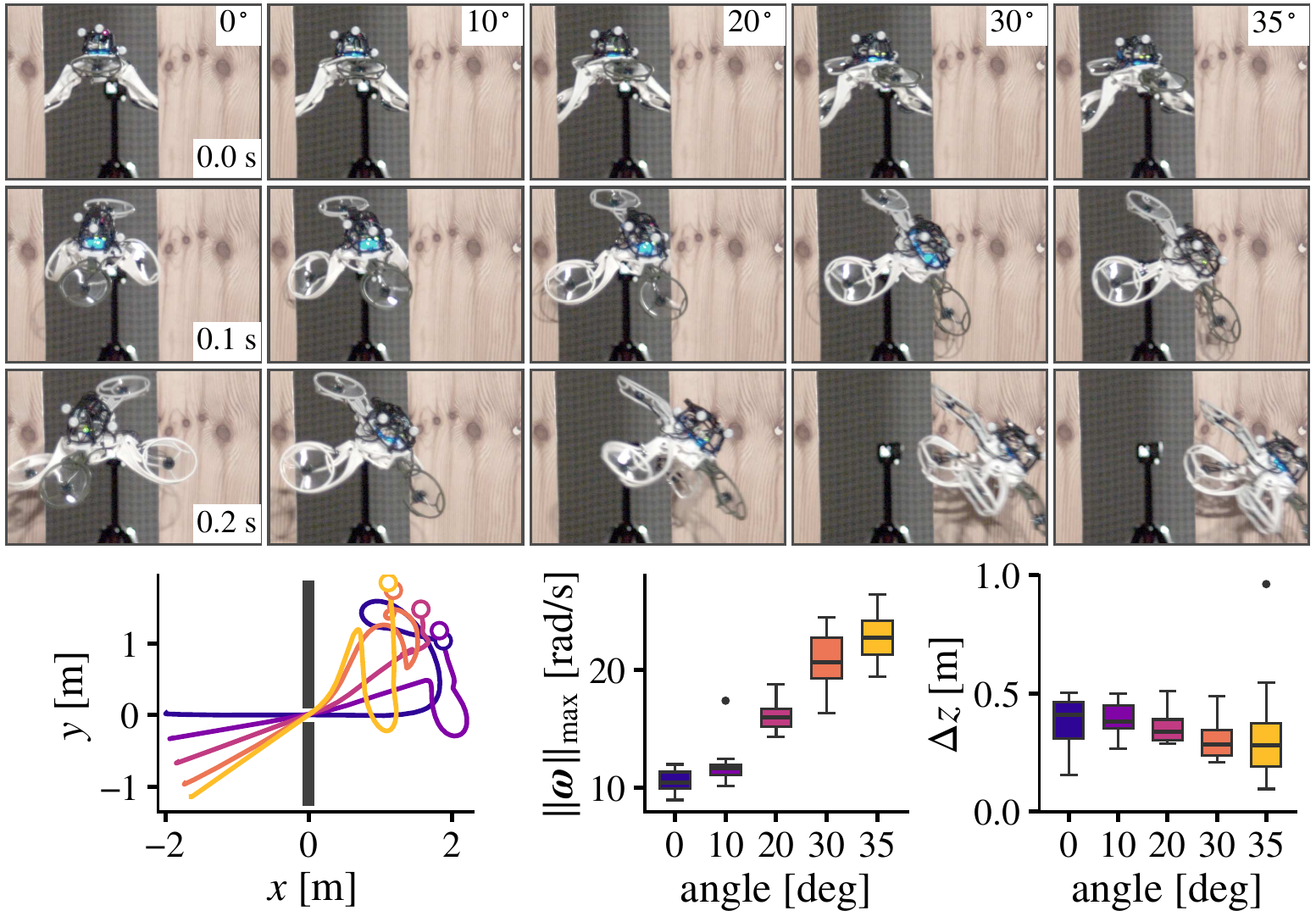
The optimization only used aligned approaches. We rotate the reference path about the center of a 20 cm opening by 0 to 35 degrees, with 20 traversals per angle. Traversal is reliable up to 30 degrees.

Traversals at approach angles from 0 to 35 degrees.

Robustness

We repeat the traversal of a 20 cm opening 20 times in a row at each approach angle from 0 to 35 degrees, 100 traversals in total. The video shows all of them in real time, about 6 minutes.

Failures over 20 traversals per approach angle
Approach angle0°10°20°30°35°
Arm dislocation00013
Loss of control00000
Altitude loss00001

Energy and error in nominal flight

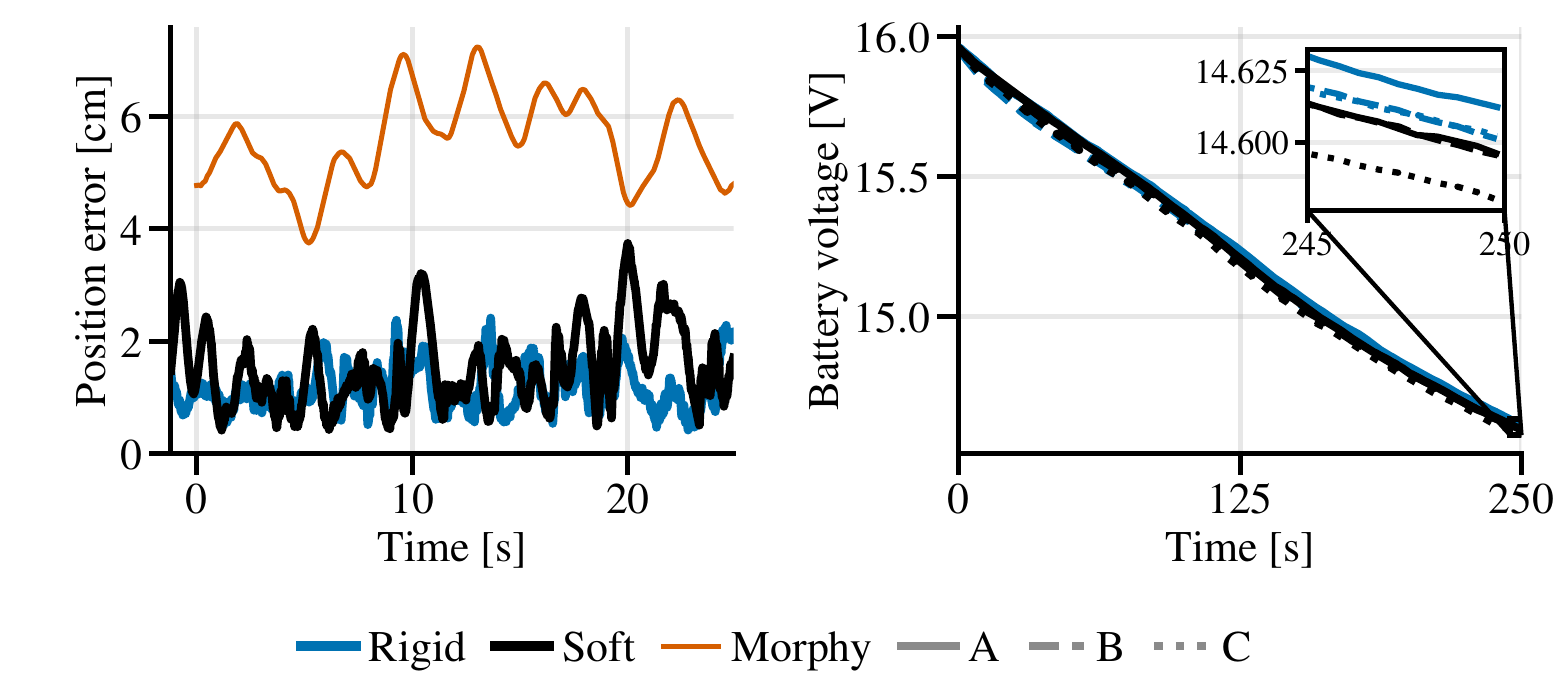
We compare the optimized drone with a rigid twin that has the same geometry and weight. Both fly a 2.4 m diameter circle at 1.5 m/s for 5 minutes, three flights each. The soft arms increase the position RMSE from 1.5 to 1.7 cm and the mean electrical power from 106.0 to 106.8 W.

Position error and battery voltage in circular flight.

Sim2real transfer

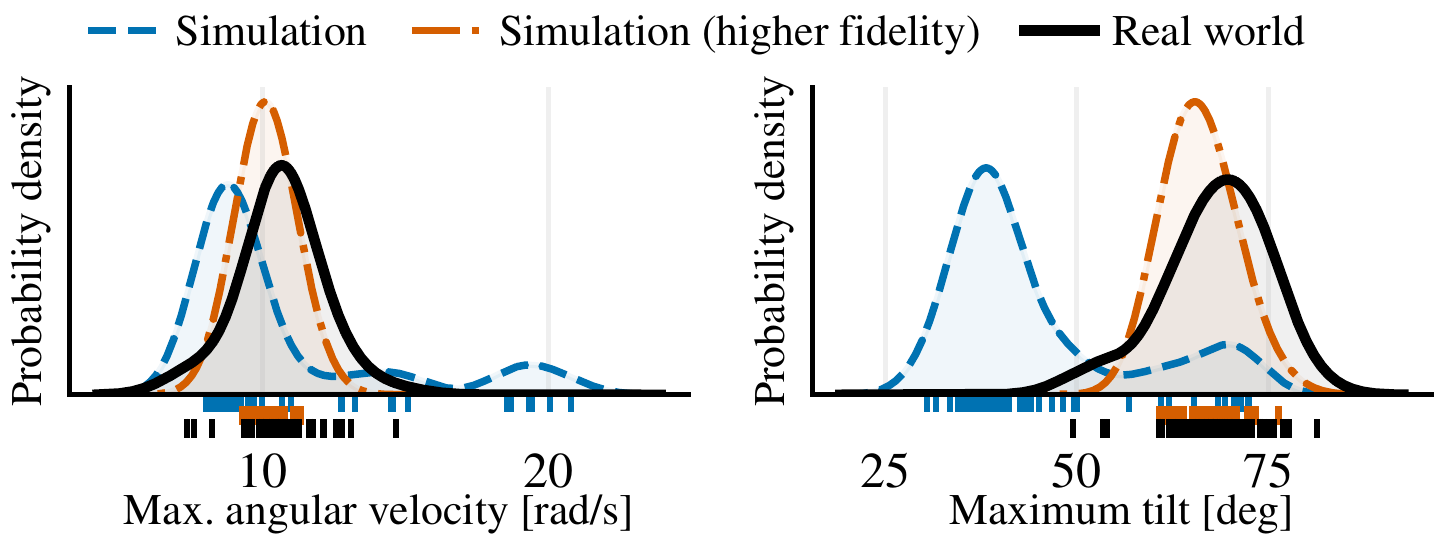
We compare 50 simulated and 50 real traversals of a 20 cm gap, measuring the maximum angular velocity and tilt in the first 0.2 s after crossing. The optimization simulator underestimates the median angular velocity by 15% and the tilt by 42%. Repeating the simulation with the mass and inertia of the real drone and with motor responses fitted to real rotor-speed logs reduces these gaps to 6% and 4%.

Distributions of maximum angular velocity and tilt, simulation and real.

BibTeX

@article{arza2026softquad,
  title   = {Task-Driven Closed-Loop Design Optimization of Passively Morphing Quadrotors for Contact-Mediated Narrow Gap Traversal},
  author  = {Arza, Etor and Girardi, Luca and Maquignaz, Gabriel and Paez, Javier and Leutenegger, Stefan and Mintchev, Stefano and Alexis, Kostas},
  journal = {arXiv preprint arXiv:2611.09272},
  year    = {2026}
}